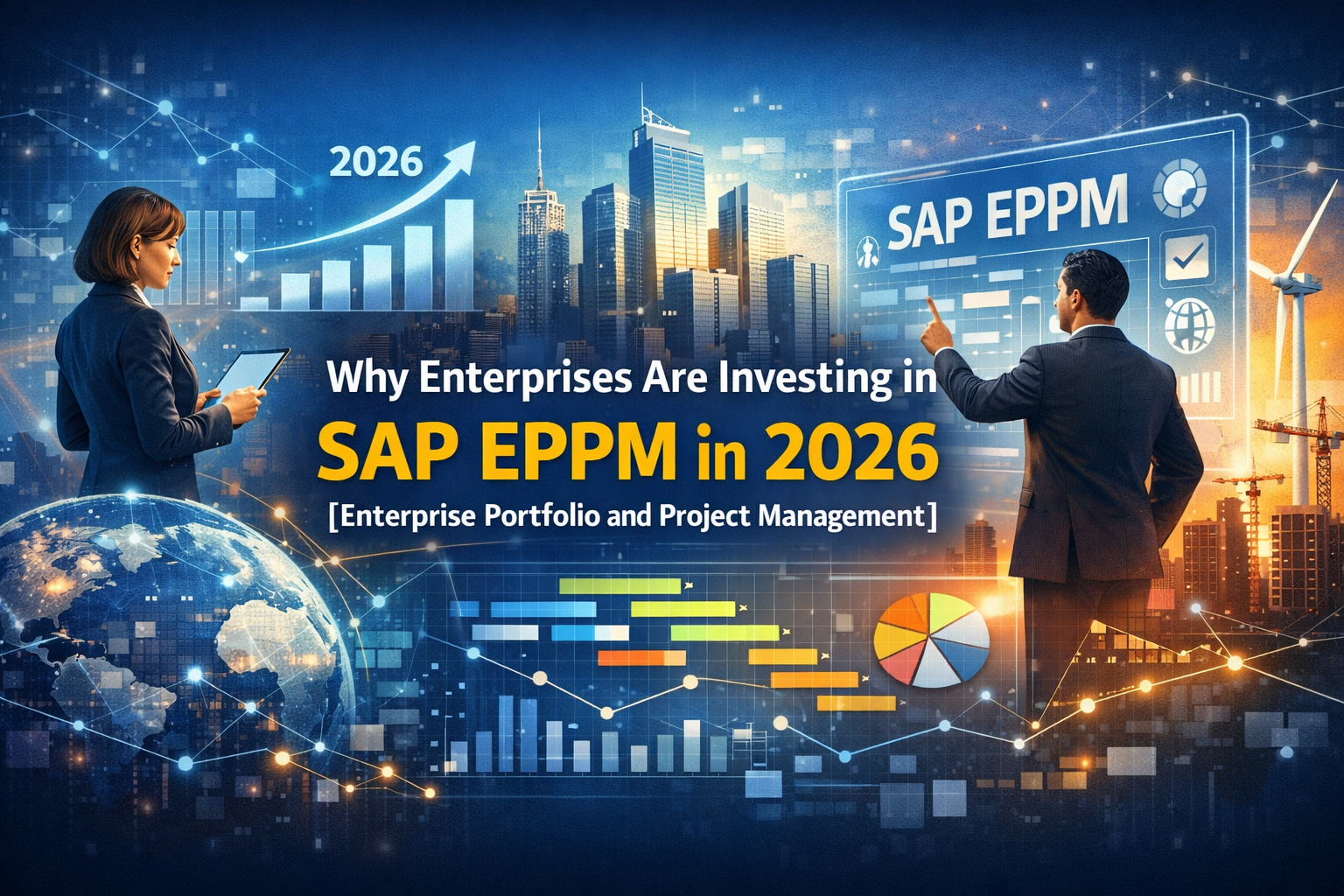
| A deep-dive into how UAE enterprises use SAP EPPM to overn complex projects, optimize resources, and drive digital transformation. |
Dubai enterprises are managing more projects, at greater scale, than most markets in the world. Infrastructure megaprojects, real estate expansions, energy transitions, and government digitization programs run concurrently, often within the same organization. That scale demands something beyond spreadsheets and disconnected project tools. It demands a system that connects portfolio strategy to on-ground execution to commercial financials.
That is exactly what SAP Enterprise Portfolio and Project Management (SAP EPPM) delivers, and it is why adoption across the UAE has grown steadily over the past several years. Enterprises are turning to SAP technologies to improve efficiency, agility, and visibility across operations that would otherwise be ungovernable.
What Is SAP Enterprise Portfolio and Project Management (EPPM)?
What Does SAP EPPM Do?
SAP EPPM is not a single module. It is a consolidation of three SAP solutions that together cover the entire project lifecycle. Most organizations use parts of this without realizing it. SAP EPPM brings all three under one integrated umbrella so decisions made at the portfolio level flow through to execution and are reflected in commercial outcomes.
| SAP Component | Primary Function |
| SAP PPM (Portfolio and Project Management) | Portfolio planning and project prioritization. Answers which projects should we invest in, and in what order? |
| SAP PS (Project System) | Project execution, scheduling, resource assignment, cost tracking, and milestone management on live projects. |
| SAP CPM (Commercial Project Management) | Revenue recognition, billing, and profitability analysis across project delivery. |
What Are the Key Features of SAP EPPM?
- Portfolio prioritization and scoring tools
- Full project lifecycle management, from planning through closure
- Financial planning, budgeting, and commercial project management
- Resource capacity planning and workforce allocation
- Real-time dashboards across portfolio, execution, and financial dimensions
Why Are Enterprises in Dubai Investing in SAP EPPM?
How Does SAP EPPM Support Digital Transformation in Dubai?
UAE organizations, covering government entities, semi-government bodies, and large private enterprises, are running digital transformation programs of varying scale. The challenge is not starting these programs. The challenge is governing them. When an organization has ten to fifty concurrent transformation initiatives, each with its own budget, sponsor, and timeline, portfolio-level control becomes critical.
SAP EPPM implementation in Dubai gives these organizations a structured way to govern digital programs. The SAP PPM component handles initiative prioritization and strategic alignment. SAP PS manages delivery. SAP CPM tracks what each initiative costs against the value it delivers.
How Does SAP EPPM Help Manage Infrastructure and Real Estate Projects?
Construction and real estate development in Dubai operate at a pace that makes project complexity almost unavoidable. A single developer may manage dozens of towers, mixed-use developments, and infrastructure contracts at once, across different geographies, contractors, and timelines.
SAP EPPM in Action: Real Estate Portfolio
A Dubai real estate group can use SAP portfolio and project management UAE capabilities to:
Track capital investment priorities across developments (SAP PPM)
Monitor construction schedules and contractor performance (SAP PS)
Manage billing milestones and revenue recognition for sold units (SAP CPM)
Oil and gas companies and infrastructure developers face the same challenge. Projects run for years, involve multiple contractors, and carry significant financial risk when execution slips. SAP EPPM gives project owners the controls they need across all three layers.
How Does SAP EPPM Improve Strategic Project Prioritization?
Not every project deserves equal investment. Organizations that struggle with this tend to approve too many initiatives, spread resources thin, and end up with a portfolio of half-finished projects rather than a smaller set of completed ones.
The SAP PPM component within EPPM addresses this directly. It lets organizations:
- Score and rank projects against defined strategic criteria
- Model resource demand before committing budgets
- Reallocate investment when priorities shift
- Align budget allocation toward high-ROI initiatives
Why Is Real-Time Data Important for Enterprises in Dubai?
Executives managing large project portfolios in Dubai cannot make decisions on data that is two weeks old. A delayed project in construction carries daily cost implications. A resource conflict between two concurrent initiatives can cascade quickly when it is not caught early.
SAP EPPM gives organizations real-time visibility across all three management layers. Portfolio health, project execution status, and commercial performance are visible from unified dashboards. ERP platforms such as SAP EPPM help organizations access real-time operational insights across departments, which improves both day-to-day planning and longer-term investment decisions.
How Does SAP EPPM Improve Resource and Budget Management?
Resource conflicts are one of the most common reasons projects slip. Two project managers both need the same senior engineer for two weeks at the same time. Without a system that shows aggregate demand across the portfolio, that conflict is invisible until it becomes a problem.
| Industry | Why SAP EPPM Matters |
| Real Estate and Construction | Multiple concurrent developments with different investors, contractors, and completion dates require integrated portfolio and execution control. |
| Oil and Gas | Long-duration projects with high capital expenditure and strict regulatory requirements need financial and schedule visibility across years, not quarters. |
| Infrastructure and Utilities | Government and semi-government entities running utility and transport programs need portfolio governance when public funds are at stake. |
| Manufacturing | Capital investment projects, plant upgrades, and new facility development require structured project and portfolio management at scale. |
| Government Digital Projects | Dubai’s smart city and e-government initiatives involve hundreds of concurrent digital programs. SAP EPPM governs this complexity with real data. |
| Retail and Logistics | Expansion programs, new distribution centers, and technology implementation projects benefit from structured lifecycle management. |
How Does SAP EPPM Help Manage Complex Project Portfolios?
The value of SAP EPPM for complex portfolios comes down to one thing: it replaces fragmented visibility with a connected view. Most large organizations manage their portfolio in one tool, project execution in another, and financials in a third. Data moves between them manually, which means it is always slightly out of date and occasionally wrong.
- Centralized project dashboards cover portfolio status, execution milestones, and commercial performance
- Risk tracking is built into project workflows rather than handled in a separate register
- Cross-department collaboration between finance, operations, and project teams is supported by shared data
- Project performance monitoring happens continuously, not just at monthly review meetings
How Does SAP EPPM Work With SAP S/4HANA?
SAP EPPM and SAP S/4HANA are designed to work together. SAP PS is a native module within S/4HANA, which means project execution data sits directly within the ERP. Financial data covering costs, purchase orders, and billing flows between project systems and the broader ERP without manual reconciliation.
Key Integration Points
SAP PS is native to S/4HANA: no custom integration required for project execution data.
Financial and project execution data flow seamlessly between EPPM components and the broader ERP. Real-time analytics are powered by S/4HANA’s in-memory capabilities, so dashboards reflect current data rather than last night’s batch run.
This integration matters for SAP EPPM implementation in Dubai because most large enterprises in the UAE are already running SAP S/4HANA or are in the process of migrating to it. Adding SAP EPPM on top of an existing S/4HANA environment is, in most cases, far simpler than introducing a separate project management platform requiring custom integration work.
What Are the Business Benefits of SAP EPPM?
| Business Benefit | What It Means in Practice |
| Better portfolio prioritization | Organizations invest in the right initiatives based on strategic criteria, not internal politics. |
| Improved resource utilization | Capacity planning across concurrent projects reduces overallocation and idle time. |
| Higher project success rates | Connected planning, execution, and financial management reduces the gaps that cause delays and overruns. |
| Real-time reporting | Portfolio, project, and financial dashboards reflect current data across all three EPPM components. |
| Unified data platform | A single source of truth across SAP PPM, SAP PS, and SAP CPM eliminates reconciliation between systems. |
| Strategic alignment | Projects funded and executed are traceable back to business objectives, not just operational demand. |
How Can Enterprises in Dubai Successfully Implement SAP EPPM?
A few things make SAP EPPM implementation in Dubai go better rather than worse. Local SAP partners like Saisatwik bring regional expertise, including familiarity with UAE regulatory requirements, local business practices, and the specific industries that drive project complexity in Dubai.
- Assess portfolio maturity. Before configuring anything, understand how the organization currently manages project selection, execution, and financial tracking. The gaps define what SAP EPPM needs to fix.
- Choose the right consulting partner. SAP EPPM spans three modules and touches finance, operations, and project management. A partner with shallow experience in one area will create problems that surface later in the implementation.
- Integrate with SAP S/4HANA from the start. Organizations that treat EPPM as a standalone deployment and plan to integrate later almost always create more work for themselves.
- Configure the right component mix. Not every organization needs the full SAP PPM, PS, and CPM stack on day one. A phased approach starting with portfolio governance is often more practical.
- Train project teams and stakeholders. Training needs to cover not just system navigation but the underlying processes the system supports. SAP EPPM is only useful when project managers, resource planners, and finance teams actually use it.
Why SAP EPPM Is Becoming Essential for Enterprises in Dubai
Dubai’s project economy is not slowing down. The scale and complexity of what organizations are building in real estate, infrastructure, energy, and digital services means that informal project management practices hit their limits quickly.
SAP EPPM in dubai gives enterprises a way to manage that complexity without losing strategic control. Portfolio planning, project execution, and commercial management run in one connected system. Decisions made at the top inform what happens on the ground, and what happens on the ground is visible to leadership in real time.
For enterprises in Dubai running SAP S/4HANA, implementing SAP EPPM is a practical next step that builds directly on infrastructure they already have. For those starting fresh, it is a foundation that scales with the complexity of their operations.The demand for structured project and portfolio management in the UAE is not going away. Neither is SAP EPPM’s relevance to it.
Frequently Asked Questions [ FAQs ]
What is SAP EPPM?
SAP EPPM is a consolidation of SAP PPM (Portfolio and Project Management), SAP PS (Project System), and SAP CPM (Commercial Project Management), covering portfolio strategy, project execution, and commercial financials end to end.
How is SAP EPPM different from SAP PPM?
SAP PPM handles portfolio planning and prioritization. SAP EPPM includes SAP PPM but extends it with project execution via SAP PS and commercial management via SAP CPM, giving organizations a complete view in one platform.
Why is SAP EPPM popular in Dubai?
Dubai organizations manage large-scale projects across construction, infrastructure, energy, and government programs. SAP EPPM provides the portfolio governance, execution control, and financial visibility those projects require.
Which industries use SAP EPPM in the UAE?
Real estate, construction, oil and gas, infrastructure, manufacturing, government, and logistics all use SAP portfolio and project management capabilities in the UAE.
Is SAP EPPM available in SAP S/4HANA?
Yes. SAP PS is a native SAP S/4HANA module, and SAP PPM and CPM integrate directly with S/4HANA. Most SAP EPPM implementations in Dubai run within an S/4HANA environment.
How does SAP EPPM improve project success rates?
By connecting portfolio decisions to project execution to financial outcomes, SAP EPPM reduces the information gaps that typically cause projects to run over budget or miss deadlines.

0 Comments