
Quick Answer
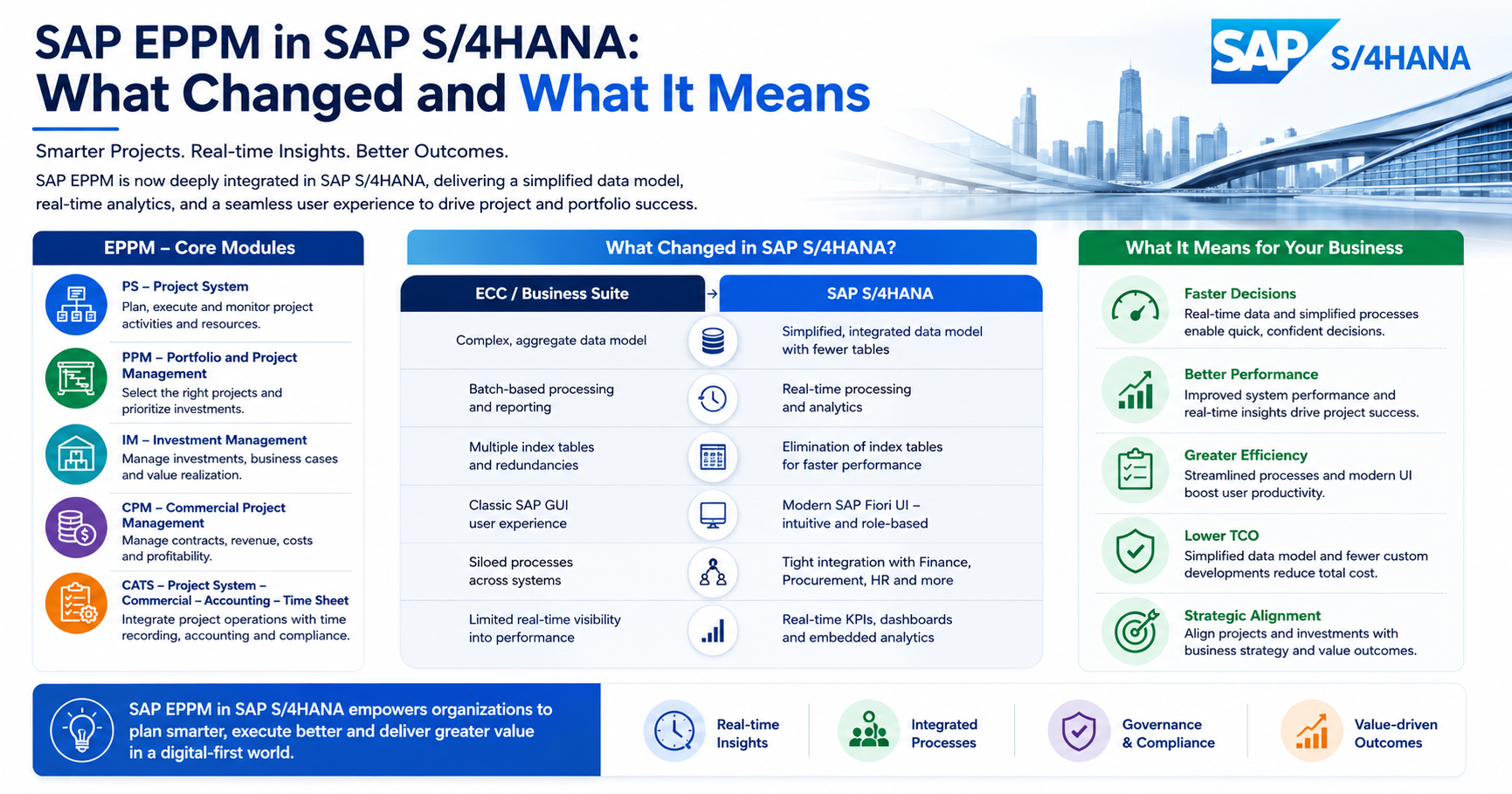
SAP EPPM in SAP S/4HANA changed in four load-bearing ways: project financials now post to the Universal Journal (table ACDOCA) instead of separate CO tables, the front end moved from SAP GUI to SAP Fiori, analytics run embedded on live data instead of overnight extracts, and SAP CPM became a native part of the platform rather than an add-on. The modules themselves survived. SAP PS, PPM, IM, CPM and CATS all run on SAP S/4HANA. SaiSatwik plans every EPPM-on-S/4HANA programme around these four changes, because each one breaks a different set of old habits.
What did SAP EPPM look like before S/4HANA?
In the SAP ECC era, SAP EPPM was a collection of loosely coupled parts. SAP PS lived inside ECC and posted costs to the classic CO tables. SAP PPM ran as a separate add-on with its own portal-based interface. SAP CPM shipped as a bolt-on with its own database schema. Project reporting meant batch extracts into SAP BW, refreshed overnight.
That architecture worked. It also created the reconciliation industry every ECC-era finance controller knows too well. A project manager’s view of actuals and the general ledger’s view of the same numbers could disagree until the next reconciliation run settled the argument.
The pressure to move is now a deadline, not a preference. SAP has committed mainstream maintenance for ECC only through 2027, which is why most EPPM modernisation conversations today are really S/4HANA migration conversations.
What actually changed for SAP EPPM in S/4HANA?
Here is the change map SaiSatwik walks clients through at the start of every EPPM-on-S/4HANA engagement.
| Area | SAP ECC Era | SAP S/4HANA | What It Means |
|---|---|---|---|
| Project financials | Costs in CO tables (COEP, COSP), reconciled to FI | Every posting lands in the Universal Journal (ACDOCA) | One version of project truth; reconciliation work disappears |
| User experience | SAP GUI transactions (CJ20N, CJ40, CAT2) | Fiori apps in the browser, GUI still available for power users | Executives and casual users finally use the system directly |
| Analytics | Overnight BW extracts, day-old dashboards | Embedded analytics on live ACDOCA data via CDS views | Margin and budget positions are current at the moment you look |
| SAP PPM | Separate add-on, portal UI, periodic sync with PS | Runs on the same S/4HANA stack with Fiori dashboards | Portfolio decisions read live project data, not synced copies |
| SAP CPM | Bolt-on with its own schema | Native S/4HANA component using the Universal Journal | Commercial project reporting stops being a side system |
| Time capture | CAT2 GUI transaction | Fiori “My Timesheet” app, CAT2 retained | Contractors and site staff book time from a phone browser |
How does the Universal Journal change project reporting?
The Universal Journal is the single biggest architectural shift for project-heavy businesses. In ECC, a project cost existed in several places at once: the CO line item, the FI document, the profitability segment. Each copy could age at its own pace.
In S/4HANA there is one line item, in one table, carrying the account, the WBS element, the profit centre and the margin dimensions together. When a PMO pulls a project cost report and a CFO pulls the P&L, both queries hit the same rows.
The practical effects show up fast. Month-end project settlement runs shrink. Budget-versus-actual views stop lagging behind reality. Auditors trace a project cost to the ledger in one step. According to the PMI Pulse of the Profession, poor data quality in portfolio governance is a leading driver of the 11.4 percent of project investment that gets wasted, and a single-source ledger attacks exactly that problem.
What happens to SAP PS customisations during the move?
This is where EPPM migrations get real. Twenty years of ECC usually means a thick layer of custom ABAP sitting on top of SAP PS: custom reports reading CO tables directly, user exits shaping WBS behaviour, Z-transactions the business swears it cannot live without.
Three rules of thumb hold across most estates SaiSatwik has assessed:
- Custom reports on CO tables break. Anything reading COEP or COSP directly needs rework against ACDOCA or, better, replacement with an embedded analytics view that already exists.
- Core PS logic mostly survives. WBS structures, network types, settlement rules and billing plans carry over. The SAP Simplification Item Catalog flags the exceptions, and it must be checked line by line, not skimmed.
- A third of Z-transactions are dead weight. Usage analysis before the move consistently shows a large slice of custom code that nobody has run in years. Migrating it is paying to move furniture nobody sits on.
Which SAP EPPM capabilities are new on S/4HANA?
Beyond the re-platforming, S/4HANA added capabilities the ECC stack never had.
| Capability | What It Does | Who Uses It |
|---|---|---|
| Fiori project dashboards | Live status, cost and schedule tiles without running a report | PMO, executives |
| Embedded margin analysis | Project profitability from ACDOCA, no BW round trip | Finance controllers |
| Situation handling | Push alerts when a budget threshold or date slips | Project managers |
| CDS-based custom reporting | Real-time custom views without cloning tables | IT, analysts |
| BTP extension path | Custom apps live outside the core, upgrades stay clean | Development teams |
The pattern across all five: work that used to require a specialist and a wait now happens in the browser, on live data. That is the quiet reason EPPM adoption widens after an S/4HANA move. More people can actually use it.
What should a PMO do before moving SAP EPPM to S/4HANA?
The sequencing below is the pre-work SaiSatwik runs with every client PMO. None of it requires S/4HANA licences to start.
- Inventory the project estate. Active WBS structures, open network activities, unsettled costs. Anything open at cutover multiplies migration effort.
- Run the Simplification Item Catalog against your PS and PPM footprint. This tells you which transactions, tables and functions change before anyone writes a plan.
- Measure custom-code usage. Let the usage data kill the dead Z-transactions so the migration scope shrinks before it is priced.
- Clean master data now. Project profiles, cost element groups and settlement rules migrate at whatever quality they hold on cutover day. Cleaning after go-live costs multiples more.
- Decide the PPM timing. Portfolio management can move with the core or follow in a second wave. Moving everything at once is the ambitious plan; it is rarely the cheapest one.
What does SaiSatwik do differently on EPPM-to-S/4HANA programmes?
SaiSatwik treats an EPPM move as a finance-data programme wearing a project-management coat. The first two weeks go to master-data validation and the Simplification Item review, before any conversion tooling runs. That ordering exists because rework in month four is where these programmes lose their budgets.
Scope is cut by module and by legal entity. A PS-first conversion for a mid-market client typically lands in 16 to 20 weeks, with PPM and CPM following as a second wave once ACDOCA reporting has bedded in. The SaiSatwik SAP EPPM practice runs both the greenfield and the conversion paths, and will tell you plainly which one your estate actually needs.
Related SaiSatwik Reading
This post sits between two SaiSatwik guide clusters. These are the natural next reads:
- What is SAP EPPM and why top enterprises are switching to it — the definitional pillar for the suite this post modernises.
- SAP EPPM modules explained: PS, PPM, IM, CPM and CATS — the module-by-module breakdown behind everything discussed here.
- SAP S/4HANA modules: a comprehensive guide — the wider platform these EPPM changes live inside.
- SAP ECC vs SAP S/4HANA: key differences — the platform comparison for stakeholders still weighing the move.
- How to migrate from SAP ECC to S/4HANA — the step-by-step migration guide this post’s PMO checklist feeds into.
FAQs about SAP EPPM in S/4HANA
Is SAP EPPM included in SAP S/4HANA?
The EPPM modules run on S/4HANA but licensing varies by component. SAP PS ships with the S/4HANA core. SAP PPM and SAP CPM are typically licensed separately even though they run on the same stack. Check entitlements before assuming a capability is already paid for.
Does SAP PS still exist in S/4HANA?
Yes. SAP PS remains the project execution module in S/4HANA. WBS structures, networks, settlement and milestone billing all carry forward. The changes are underneath: financial postings go to the Universal Journal, and Fiori apps sit in front of the classic transactions.
What is ACDOCA and why does it matter for projects?
ACDOCA is the Universal Journal table in SAP S/4HANA, the single line-item store for financial postings. For projects it means the WBS cost view and the general ledger are the same data, so project reporting is real-time and reconciliation between CO and FI disappears as a task.
Do I need to reimplement SAP PPM when moving to S/4HANA?
Not from zero, but it is more than a technical upgrade. Portfolio structures and scoring models carry over conceptually, while the interface moves to Fiori and integration points change. Most enterprises treat the PPM move as a second wave after the core conversion stabilises.
Can SAP EPPM run on S/4HANA Cloud?
Project management capabilities exist across S/4HANA Cloud editions, with scope differences. The private edition supports the fullest EPPM footprint, close to on-premise. The public edition covers core project financials with a leaner feature set. Capital-project-heavy enterprises usually land on private edition or on-premise for this reason.
0 Comments