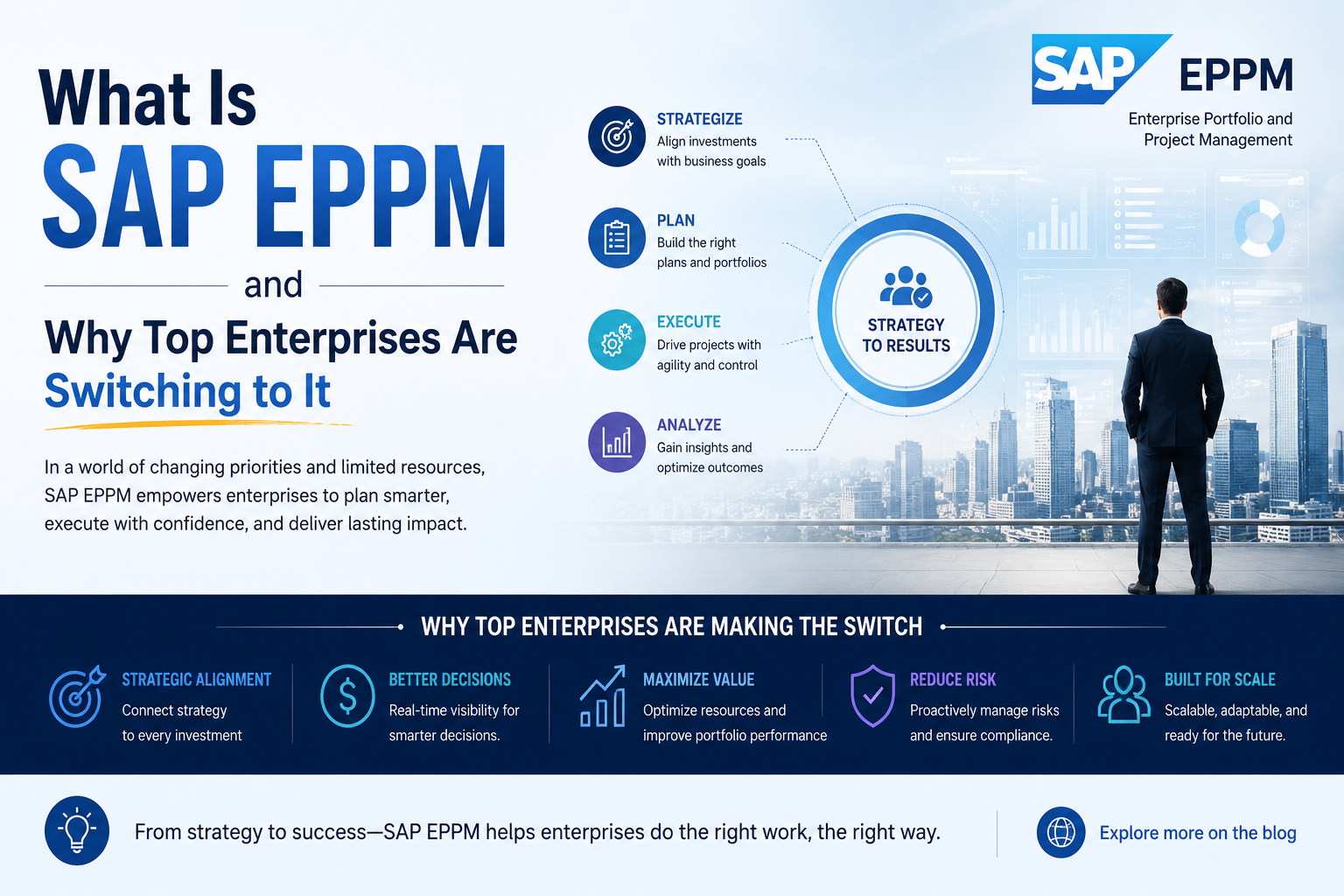
Managing hundreds of projects across multiple geographies, business units, and budgets is one of the most complex challenges modern enterprises face. Spreadsheets fall short. Siloed tools create blind spots. And disconnected data leads to poor investment decisions.
That is where SAP EPPM (Enterprise Portfolio and Project Management) enters the picture. It has become one of the most adopted project and portfolio management platforms among global enterprises, and the reasons are practical, not just technical.
This blog breaks down what SAP EPPM is, what it does, and why companies across industries are moving away from legacy systems to adopt it.
What Is SAP EPPM?
SAP EPPM stands for Enterprise Portfolio and Project Management. It is a suite of tools within the SAP ecosystem designed to help organisations plan, execute, and monitor projects and investment portfolios at scale.
Unlike basic project management tools, SAP EPPM connects project execution to financial planning, resource management, risk analysis, and strategic decision-making, all within a single integrated environment. It sits on top of SAP’s broader ERP infrastructure, which means data flows seamlessly between project management, finance, HR, procurement, and operations.
SAP EPPM is commonly used in industries such as:
- Engineering and construction
- Oil, gas, and utilities
- Manufacturing
- IT and telecommunications
- Public sector and infrastructure
It is particularly well-suited for capital-intensive industries where project costs, timelines, and resource allocation directly impact business performance.
Core Capabilities of SAP EPPM
Understanding what SAP EPPM can do helps explain why enterprises are drawn to it. Here are its primary functional areas:
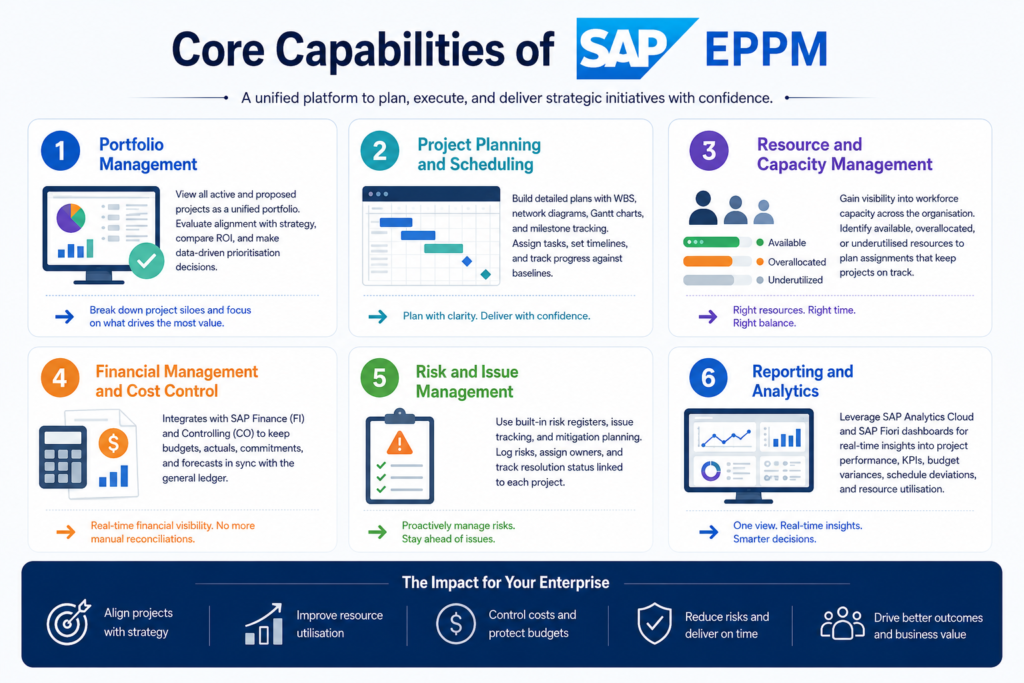
1. Portfolio Management
SAP EPPM allows leadership teams to view all active and proposed projects as a unified portfolio. Decision-makers can evaluate which projects align with business strategy, compare return on investment across initiatives, and make data-driven prioritisation decisions.
This replaces the common problem of project siloes, where business units run projects independently without visibility into how they affect overall organisational goals.
2. Project Planning and Scheduling
The platform supports detailed project planning with work breakdown structures (WBS), network diagrams, Gantt charts, and milestone tracking. Project managers can create realistic timelines, assign tasks, and track progress against baselines.
3. Resource and Capacity Management
One of the most valuable features is the ability to manage workforce capacity across the entire organisation. SAP EPPM shows which resources are available, overallocated, or underutilised, so project managers can plan assignments without causing burnout or delays.
4. Financial Management and Cost Control
SAP EPPM integrates directly with SAP Finance (FI) and Controlling (CO) modules. This means project budgets, actual costs, commitments, and forecasts are always connected to the general ledger. Finance teams no longer need to reconcile project data manually with accounting records.
5. Risk and Issue Management
The platform includes built-in risk registers, issue tracking, and mitigation planning. Project managers can log risks, assign owners, and track resolution status, all linked to the relevant project.
6. Reporting and Analytics
SAP EPPM connects with SAP Analytics Cloud and SAP Fiori dashboards to provide real-time visibility into project performance. Executives can monitor KPIs, budget variances, schedule deviations, and resource utilisation from a single screen.
SAP EPPM vs Traditional Project Management Tools
Here is a straightforward comparison to show where SAP EPPM differentiates itself:
| Feature | Traditional PM Tools | SAP EPPM |
|---|---|---|
| Financial integration | Manual or limited | Native ERP integration |
| Portfolio-level view | Often absent | Built-in portfolio dashboards |
| Resource management | Basic or siloed | Enterprise-wide capacity planning |
| Risk management | Add-on or manual | Integrated risk registers |
| Scalability | Limited | Designed for large enterprises |
| Data consistency | Often duplicated | Single source of truth |
For organisations running SAP S/4HANA or any SAP ERP platform, the integration advantage of EPPM is especially significant.
Why Top Enterprises Are Switching to SAP EPPM
The shift toward SAP EPPM is not happening in isolation. It reflects a broader trend: enterprises are tired of managing complexity with tools that were not built for complexity.
Reason 1: Single Source of Truth
Many organisations run separate tools for project tracking, cost management, resource planning, and reporting. The result is inconsistent data, time wasted on reconciliation, and decisions made on outdated information.
SAP EPPM eliminates this by connecting all project-related data to the same system that runs finance, procurement, and HR. Every team works from the same numbers, updated in real time.
Reason 2: Strategic Investment Alignment
According to the PMI Pulse of the Profession research, organisations that align portfolios to strategy waste 28% fewer resources on cancelled initiatives. Boards and C-suites are asking harder questions: Which projects are driving ROI? Are we investing in the right priorities? What is the risk exposure across our portfolio?
SAP EPPM gives leadership the visibility to answer these questions with confidence. Portfolio scoring, scenario modelling, and investment benchmarking tools allow organisations to align capital allocation with business strategy.
Reason 3: Better Resource Utilisation
Overallocation and underutilisation are both costly. SAP EPPM provides a real-time view of workforce capacity, so organisations can deploy their people more effectively, reduce hiring pressure during peak periods, and avoid project delays caused by resource conflicts.
Reason 4: Regulatory and Compliance Requirements
Industries such as energy, pharmaceuticals, and construction face strict project documentation and audit requirements. SAP EPPM supports audit trails, document management, and compliance reporting, making it easier for organisations to demonstrate governance.
Reason 5: Scalability Across Global Operations
Managing projects across multiple countries, currencies, and legal entities is where smaller tools often break down. SAP EPPM is built for global enterprises. It handles multi-currency budgeting, multilingual interfaces, and localisation requirements out of the box.
Reason 6: Integration With SAP Ecosystem
For organisations already running SAP S/4HANA, SuccessFactors, or SAP Procurement, adding EPPM feels natural. Data does not need to be exported, transformed, or re-entered. The connection between project execution and enterprise operations is immediate.
Who Should Use SAP EPPM?
SAP EPPM is not the right fit for every organisation. It is best suited for:
- Large enterprises with complex, multi-project environments
- Companies already using SAP ERP who want to extend into project management
- Industries with capital-intensive projects where financial accuracy is critical
- Organisations that need portfolio-level oversight, not just task-level tracking
- Businesses with distributed teams requiring centralised resource and cost visibility
If you are a small business managing a handful of projects, SAP EPPM would be excessive. But if you are coordinating hundreds of projects with thousands of resources and strict financial controls, it becomes a strategic asset.
Implementation Considerations
Switching to SAP EPPM is not a plug-and-play process. Organisations typically work with an SAP EPPM implementation partner such as SaiSatwik to configure the system, migrate data, and train users. Key factors to plan for include:
- Defining portfolio structures and project hierarchies
- Aligning EPPM with existing SAP FI/CO configuration
- Training project managers and PMO staff
- Establishing governance processes for portfolio reviews and approvals
A phased rollout, starting with portfolio management or project financials, often produces faster results than a full simultaneous implementation.
The Future of SAP EPPM
SAP continues to invest in EPPM capabilities. Integrations with SAP Business AI allow for predictive project risk analysis and intelligent resource recommendations. Cloud deployment options through SAP BTP (Business Technology Platform) are making EPPM more accessible without the overhead of traditional on-premise installations.
As organisations move toward data-driven project governance, SAP EPPM is positioned to become an even more central part of enterprise operations.
Related SaiSatwik Reading on SAP EPPM
Once you have the definition down, these companion posts go deeper on the buyer decisions and regional angles teams work through when choosing SAP EPPM:
- Why enterprises are investing in SAP EPPM in 2026 — the current 2026 investment thesis, with a Dubai-market lens.
- SAP Investment Management vs SAP EPPM — the head-to-head buyers ask most often before shortlisting a module.
- Why Saudi enterprises are adopting SAP EPPM for large project portfolios — the Saudi Vision 2030 execution angle and how mega-project owners are standardising portfolio governance.
- 8 enterprise business challenges solved by SAP EPPM — the concrete pain-points-to-solution mapping most operator readers ask for after the definition lands.
- SAP EPPM modules explained: PS, PPM, IM, CPM and CATS — the module-by-module breakdown, including which one to start with by pain signal.
- SAP EPPM in SAP S/4HANA: what changed — the platform-shift guide covering the Universal Journal, Fiori, and what a PMO should do before the move.
- SAP EPPM implementation roadmap — the five phases, realistic timelines, and the data-first sequencing that keeps a rollout on budget.
- SAP EPPM architecture and integration — the layered stack and every integration point (FICO, HCM, MM/SD, SAC, Fiori, BTP) that makes the data flow.
- SAP EPPM licensing explained — the per-module license structure, cost drivers, and how to scope the footprint before a quote.
- SAP EPPM best practices for capital projects — portfolio gating, WBS discipline, real-time cost control, and stage-gate governance that keep a capital portfolio on budget.
Frequently Asked Questions (FAQ)
Q1: What does SAP EPPM stand for? SAP EPPM stands for Enterprise Portfolio and Project Management. It is a suite of tools within the SAP ecosystem designed to manage projects, resources, budgets, and portfolios at an enterprise level.
Q2: Is SAP EPPM the same as SAP PS? No. SAP PS (Project System) is the older, traditional project management module within SAP ERP. SAP EPPM is a broader suite that includes project and portfolio management capabilities and is more modern, scalable, and integrated with SAP Fiori and SAP Analytics Cloud.
Q3: Can SAP EPPM be used without SAP S/4HANA? SAP EPPM is most powerful when integrated with SAP ERP systems like S/4HANA. However, some components can be deployed in hybrid or standalone configurations. An SAP partner can advise on the best deployment model for your situation.
Q4: How long does an SAP EPPM implementation typically take? Implementation timelines vary based on scope and complexity. A focused implementation covering core portfolio and project features can take three to six months. A full enterprise rollout across multiple business units may take twelve to eighteen months or longer.
Q5: What industries benefit most from SAP EPPM? SAP EPPM is widely used in engineering and construction, oil and gas, utilities, pharmaceuticals, manufacturing, public sector infrastructure, and IT services, particularly where capital projects and large workforces require coordinated management.
Q6: How does SAP EPPM support remote or distributed teams? SAP EPPM runs on SAP Fiori, a modern web-based interface accessible from any browser or device. Distributed teams can update project status, log time, flag risks, and access dashboards from any location, supporting global project delivery.
Q7: What is the difference between project management and portfolio management in SAP EPPM? Project management in SAP EPPM focuses on planning, executing, and tracking individual projects. Portfolio management provides a higher-level view, helping leadership evaluate and prioritise which projects to fund, continue, pause, or cancel based on strategic and financial criteria.
0 Comments