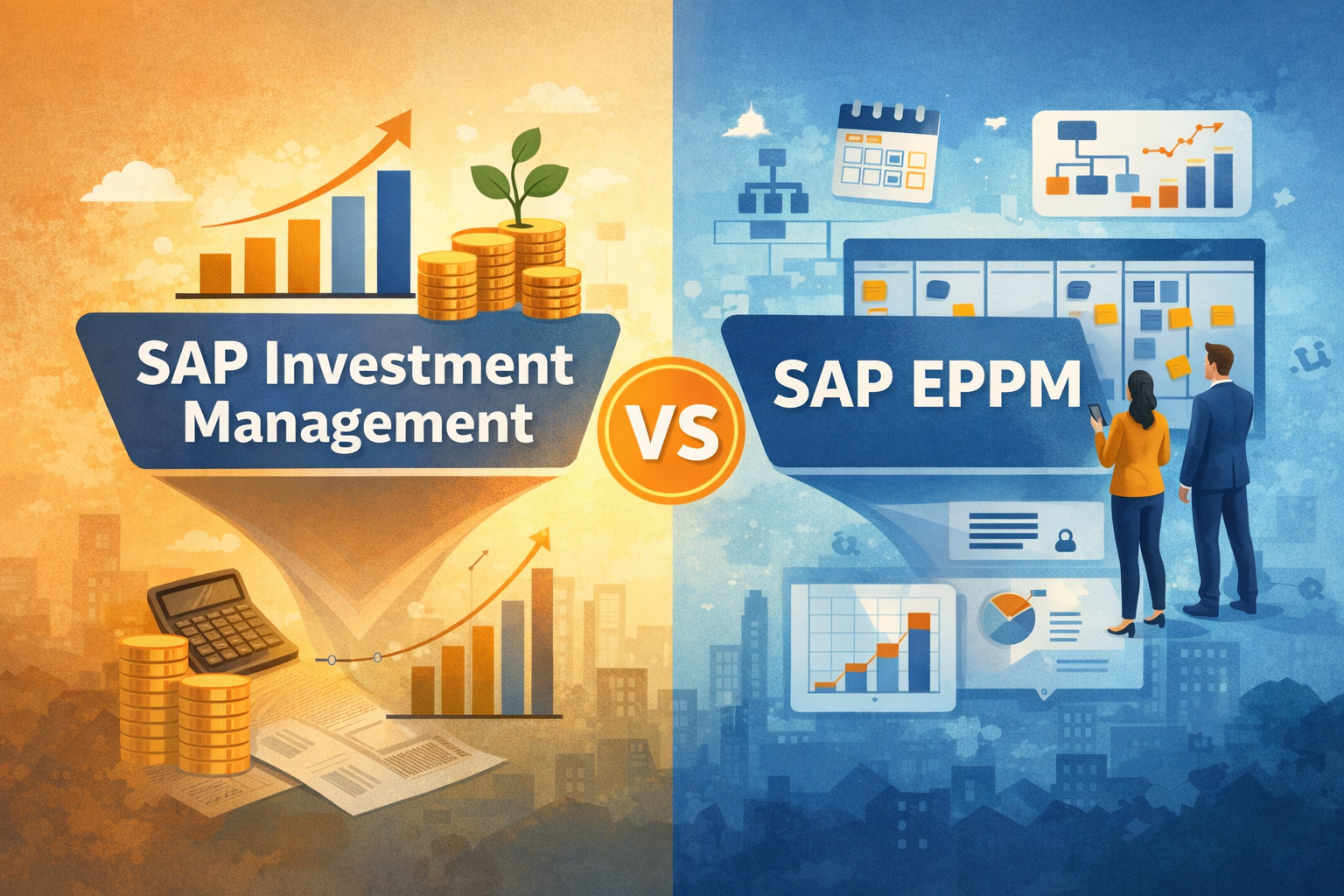
The confusion between SAP IM and SAP EPPM comes up regularly, and it is understandable. Both touch projects. Both involve budgets. But they operate at different layers of the organization and solve different problems. SAP Investment Management sits in the financial control layer. SAP EPPM sits in the project governance and execution layer.
Getting this distinction right matters because deploying the wrong module, or deploying one without understanding how it relates to the other, creates gaps that show up later as data inconsistencies, budget overruns that nobody caught, or projects that got approved without proper portfolio analysis.
What Is SAP Investment Management (IM)?
What Does the SAP Investment Management Module Do?
SAP Investment Management is a financial module. It controls how capital investment budgets are planned, approved, distributed, and tracked. If an organization wants to buy new machinery, build a plant, or fund a long-term infrastructure project, SAP IM is where the financial governance for that investment lives.
It works closely with Asset Accounting and Controlling inside SAP, so capital expenditure flows from investment approval through to asset creation and depreciation without manual handoffs between systems.
| SAP IM Function | What It Controls |
| Investment Program Planning | Defines the hierarchy of capital investment programs across business units or project categories |
| Budget Approval Workflows | Routes capital appropriation requests through approval chains before funds are committed |
| Asset Lifecycle Funding | Tracks how investment budgets convert into fixed assets over the project lifecycle |
| Integration with SAP FI and CO | Links investment spending directly to financial accounting and cost controlling in real time |
| Investment Monitoring | Tracks actual vs. planned spend across investment programs with variance reporting |
What Are the Key Features of SAP Investment Management?
- Investment program planning and hierarchy management
- Budget control with tolerance limits and availability checks
- Capital appropriation requests (CARs) with multi-level approval workflows
- Integration with SAP FI and CO for financial posting and cost tracking
- Monitoring of planned versus actual investment spend
- Settlement of project costs to fixed assets or cost centers
Which Businesses Use SAP Investment Management? SAP IM is most common in industries where capital expenditure is large, long-duration, and tightly regulated. The financial governance requirements in these sectors make informal budget tracking inadequate
| Industry | Typical SAP IM Use Case |
| Manufacturing | Funding plant upgrades, new production lines, and machinery replacement programs |
| Utilities | Managing capital budgets for grid infrastructure, water treatment facilities, and network upgrades |
| Energy | Tracking CAPEX across exploration, production, and refinery investment programs |
| Infrastructure | Governing public or private investment programs across roads, ports, and transport assets |
What Is SAP Enterprise Portfolio and Project Management (EPPM)?
What Does SAP EPPM Do?
SAP EPPM is not a single module. It is a consolidation of three SAP components that together cover the full project lifecycle, from strategic portfolio decisions through to execution and commercial outcomes.
| EPPM Component | What It Covers |
| SAP PPM (Portfolio and Project Management) | Portfolio planning, project prioritization, and strategic alignment. Answers the question: which projects should the organization fund and in what order? |
| SAP PS (Project System) | Project execution, scheduling, work breakdown structures, resource assignments, and cost tracking on active projects |
| SAP CPM (Commercial Project Management) | Revenue recognition, billing milestones, and project-level profitability management for customer-facing or commercial projects |
Together these three components give organizations visibility from portfolio strategy down to individual project tasks and up again to commercial financials. That end-to-end view is what distinguishes SAP EPPM from standalone project management tools.
What Are the Main Features of SAP EPPM?
- Portfolio prioritization and scoring across strategic criteria
- Full project lifecycle management from initiation through closure
- Resource capacity planning and workforce allocation across concurrent projects
- Financial planning and commercial project management via SAP CPM
- Real-time reporting dashboards spanning portfolio, execution, and financial dimensions
- Risk tracking built into project workflows
- Cross-department collaboration between project, finance, and operations teams
Which Businesses Benefit From SAP EPPM?
SAP EPPM applies wherever organizations manage multiple concurrent projects that need to be governed at the portfolio level, not just executed individually.
| Business Context | How SAP EPPM Helps |
| IT Project Management | Governs technology investment portfolios, aligns IT projects with business strategy, and tracks delivery against commitments |
| Research and Development | Prioritizes R&D initiatives against budget and strategic fit, manages multi-phase project execution |
| Product Development Programs | Coordinates cross-functional teams across product launch programs with resource and timeline visibility |
| Digital Transformation | Governs large transformation portfolios where dozens of concurrent initiatives compete for the same resources and budget |
| Construction and Infrastructure | Combines portfolio-level investment governance with project execution and commercial billing in one platform |
What Are the Key Differences Between SAP IM and SAP EPPM?
The clearest way to understand the difference between SAP Investment Management and SAP EPPM is to look at what decision each module supports. SAP IM answers financial questions about capital commitments. SAP EPPM answers operational and strategic questions about project portfolios.
| Feature | SAP Investment Management (IM) | SAP EPPM |
| Primary Purpose | Capital investment budgeting and financial control | Portfolio and project management across the full lifecycle |
| Core Focus | Financial governance of capital expenditure | Strategic project planning, execution, and commercial management |
| Typical Use | Infrastructure, asset, and CAPEX investment programs | Managing multiple strategic or operational project portfolios |
| SAP Integration | SAP FI, CO, and Asset Accounting | SAP PS, HR, Analytics, and S/4HANA Finance |
| Decision Scope | Investment approvals and budget availability | Project prioritization, resource allocation, and delivery governance |
| User Profile | Finance controllers and investment managers | Project managers, portfolio managers, and PMO teams |
| Output | Approved budgets, cost settlements, asset creation | Project plans, resource schedules, portfolio dashboards, billing |
When Should a Business Use SAP Investment Management?
SAP IM is the right tool when the primary concern is financial governance of capital investments rather than project execution or portfolio strategy.
- Planning capital-intensive investments where budget availability checks are needed before any project begins
- Budgeting for plant upgrades, machinery, or infrastructure where costs will eventually settle to fixed assets
- Managing long-term asset funding across multiple business units with different budget owners
- Tracking capital expenditure at program level against annual or multi-year CAPEX budgets
- Running approval workflows for capital appropriation requests before committing financial resources
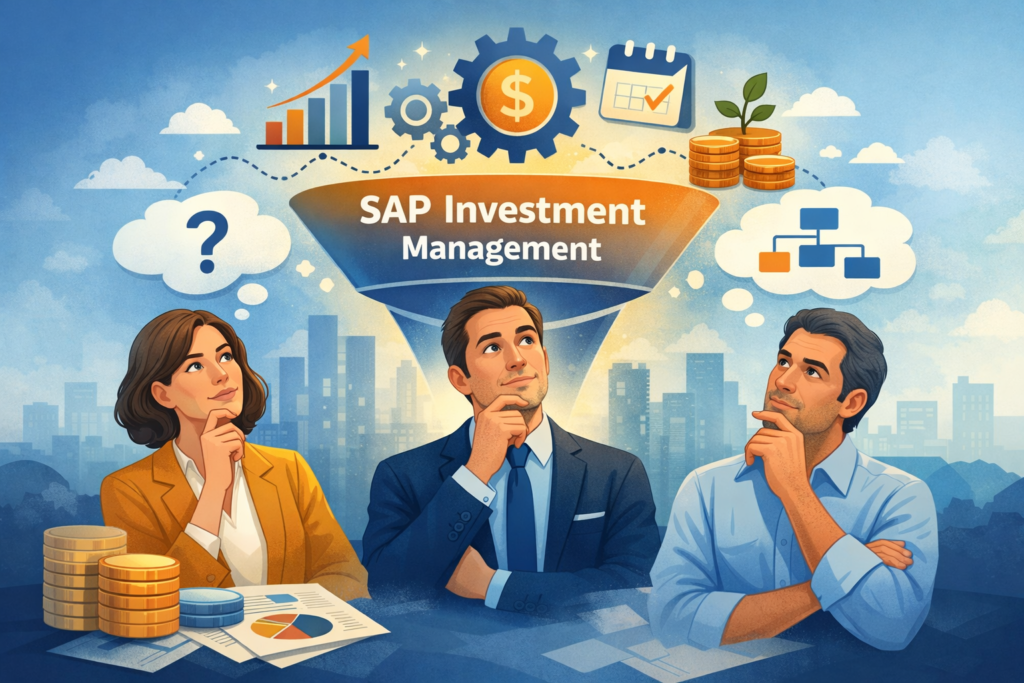
A utility company planning a five-year grid modernization program would use SAP IM to govern the investment budget, run approval workflows for individual project funding requests, and track how spending converts to capitalized assets. The project execution on those same initiatives might run through SAP PS as part of SAP EPPM.
When Should Companies Use SAP EPPM?
SAP EPPM fits situations where the challenge is not just budgeting an investment but governing a portfolio of projects against strategy, executing them reliably, and managing the commercial outcomes.
- Managing multiple strategic projects simultaneously where resource conflicts and priority decisions need a governed process
- Aligning a project portfolio with business strategy, so that funded projects actually connect to stated objectives
- Optimizing resource allocation across concurrent projects where the same teams work on multiple initiatives
- Tracking project portfolio performance through real-time dashboards rather than periodic spreadsheet updates
- Managing commercial project delivery where billing, revenue recognition, and client reporting are part of the project scope
A technology company running fifteen digital transformation initiatives simultaneously would use SAP EPPM to prioritize the portfolio, allocate developer and architect capacity across projects, and track commercial outcomes for client-facing programs. SAP IM might govern the capital investment budget that funds several of those same initiatives.
Can SAP Investment Management and SAP EPPM Work Together?
Yes, and for large enterprises this is typically how both modules get used. SAP IM governs the financial side of capital investment. SAP EPPM governs the project execution and portfolio management side. The integration between them closes the gap between budget approval and delivery.
Here is how a typical integrated workflow runs:
| 01 Investment Request | 02 Budget Approval | 03 Project Creation | 04 Portfolio Review | 05 Execution | 06 Budget Tracking |
| Business case submitted via SAP IM capital appropriation request | SAP IM routes request through financial approval workflow | Approved investment triggers project creation in SAP PS within EPPM | SAP PPM within EPPM scores and prioritizes the project against the portfolio | Project runs in SAP PS with resources, schedule, and cost tracking | Actual costs post back to SAP IM for CAPEX reporting and asset settlement |
Without this integration, organizations often have investment budgets approved in one system and projects running in another with no automated cost flow between them. Reconciling the two manually takes time and introduces errors that affect both financial reporting and project decisions.
How Does SAP IM vs SAP EPPM Work in SAP S/4HANA?
Both modules are available in SAP S/4HANA, though the architecture has evolved. SAP PS is native to S/4HANA, meaning project execution data sits directly in the core ERP without a separate integration. SAP PPM and SAP CPM integrate with S/4HANA through standard APIs and are accessible via SAP Fiori dashboards.
| SAP IM in S/4HANA Investment Management is available in S/4HANA and continues to work as the financial governance layer for CAPEX programs. The integration with Asset Accounting and Controlling in S/4HANA is tighter than in ECC, with real-time financial posting replacing batch updates. |
| SAP EPPM in S/4HANA SAP PS runs natively within S/4HANA. SAP PPM and CPM are connected through the SAP Business Technology Platform. Together they provide portfolio dashboards and project analytics via SAP Fiori, with real-time data from the S/4HANA in-memory engine rather than overnight batch runs. |
For organizations running S/4HANA or planning a migration, the practical advice is to treat SAP IM and SAP EPPM as complementary layers in the same ERP ecosystem rather than separate deployments. The financial data from SAP IM and the project data from SAP EPPM reference the same master data, cost objects, and organizational structures.
Which Is Better: SAP Investment Management or SAP EPPM?
This question tends to get asked when organizations are choosing between them, but the more useful question is: what problem are you trying to solve?
| Your Primary Need | Recommended Module |
| Controlling capital budgets and CAPEX approval workflows | SAP Investment Management (IM) |
| Managing a portfolio of projects strategically with execution visibility | SAP EPPM |
| Both financial governance of investments and project portfolio management | SAP IM and SAP EPPM working together |
| Project execution only, without portfolio governance | SAP PS as a standalone component within EPPM |
SAP IM and SAP EPPM are complementary rather than competing. Most large manufacturing, energy, infrastructure, and government organizations run both. SAP IM controls whether an investment gets approved and how the budget is distributed. SAP EPPM controls how the resulting projects are prioritized, executed, and delivered.
Choosing the Right SAP Solution for Investment and Project Management
The difference between SAP Investment Management and SAP EPPM comes down to the layer of the organization each one operates in. SAP IM sits in financial control. SAP EPPM sits in project governance and execution.
For organizations that manage large capital programs, both modules are likely relevant. SAP IM governs the investment budget and approval chain. SAP EPPM governs what happens to the project once that budget is approved. The integration between the two closes the loop between financial commitments and delivery outcomes.
| Getting the module selection right from the start saves significant rework later. Saisatwik works with enterprises across the UAE to implement SAP IM and SAP EPPM in configurations that reflect how each organization actually manages capital investment and project delivery, not just how the modules work in isolation. The goal is not to have both modules running. The goal is to have them connected, so investment decisions and project execution share the same data. |
Related SaiSatwik Reading on SAP EPPM
Once the SAP IM vs SAP EPPM decision is made, these companion posts cover what typically comes next:
- What is SAP EPPM and why top enterprises are switching to it — definitional pillar with the full capability breakdown.
- Why enterprises are investing in SAP EPPM in 2026 — the current investment thesis, with a Dubai-market focus.
- Why Saudi enterprises are adopting SAP EPPM for large project portfolios — the Saudi Vision 2030 mega-project governance angle.
0 Comments