Why Productivity Is a Growing Challenge for SMEs and Freelancers
Running a small business or working as a freelancer has never been more demanding. India’s Ministry of MSME now counts more than 6.3 crore registered small businesses, and most of them run day-to-day operations on the same overloaded phones and inboxes their founders started with. With limited budgets, lean teams, and rising competition from every direction, the pressure to deliver more with less is constant. Yet for most SMEs and independent professionals, the real productivity crisis is not a lack of effort. It is a lack of the right systems.
The difference between working more and working smarter is not a motivational cliche. It is the gap between businesses that scale sustainably and those that stay perpetually overwhelmed. When your tools are fragmented, your workflows are manual, and your data is scattered, every hour of work carries unnecessary friction.
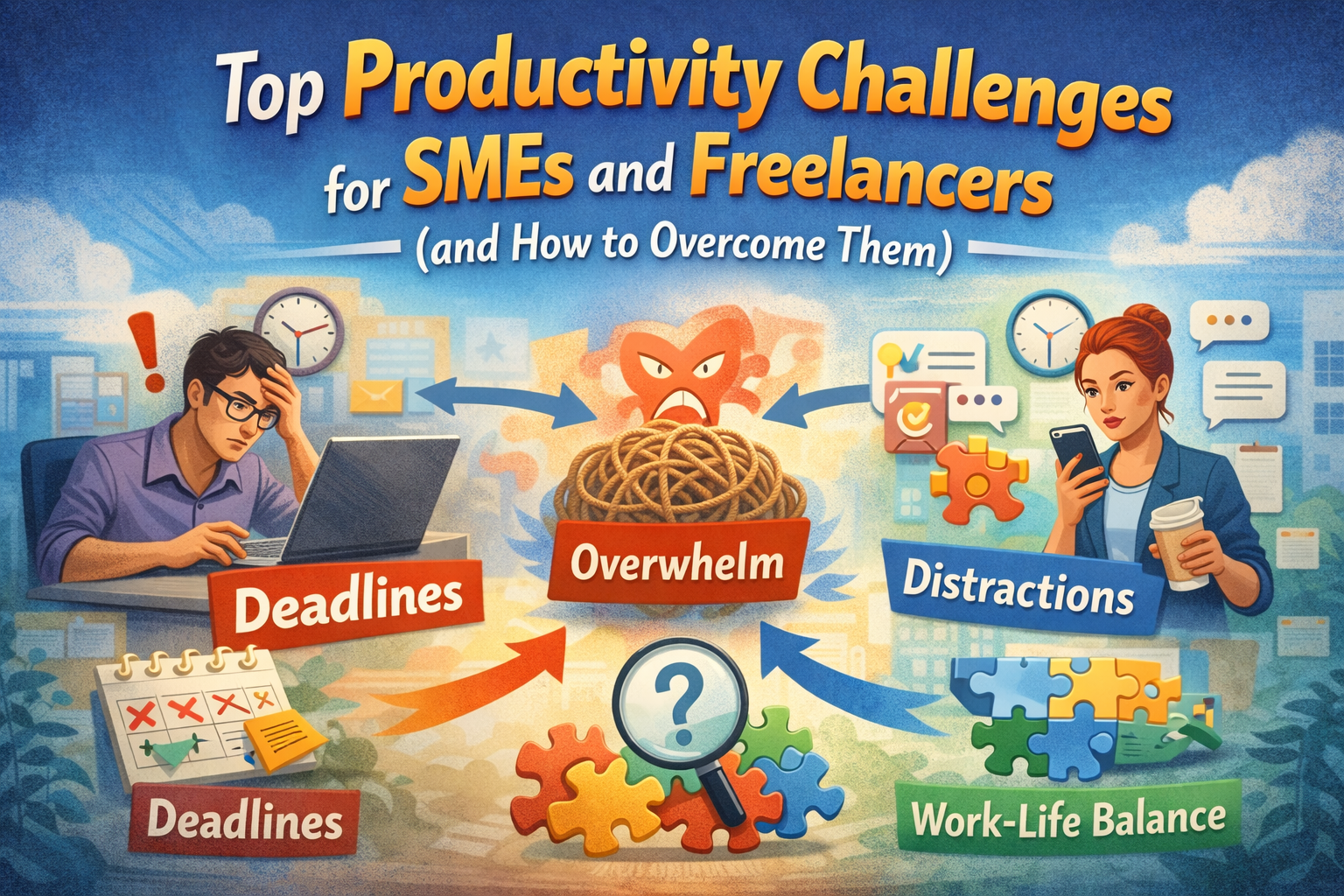
This guide identifies the six most common productivity challenges facing SMEs and freelancers today, and offers practical, actionable solutions for each one. Whether you are a solo consultant juggling multiple clients or a small team trying to grow without burning out, the insights here are designed to help you work with greater clarity and less chaos.
Challenge 1: Using Too Many Disconnected Tools
The Problem
Most small businesses start by picking the best individual tool for each function: one app for project management, another for invoicing, a separate CRM, a different platform for HR, and yet another for communication. Before long, the average SME or freelancer is switching between five, six, or even more applications just to get through a standard workday.
Each context switch costs time and mental energy. And when your data lives in separate systems that do not talk to each other, you end up doing the same data entry multiple times across different platforms.
The Impact
Constant app switching breaks focus and reduces the quality of deep work. Duplicate data entry creates opportunities for errors and inconsistencies. And paying for multiple software subscriptions adds up quickly, often for features that overlap or go unused.
How to Overcome It
The solution is consolidation. Identify the core functions your business relies on and look for platforms that handle multiple needs within a single workspace. When your CRM, project management, billing, and workflows all live together, you eliminate the switching cost and dramatically reduce the administrative overhead.
This is exactly the kind of problem that MAVRO, an all-in-one business workspace, is built to solve. Rather than managing a fragmented stack of tools, MAVRO brings your essential business functions into one unified environment, so you can spend less time managing software and more time delivering value.
Challenge 2: Poor Task and Project Visibility
The Problem
When tasks live across email threads, WhatsApp messages, spreadsheets, and sticky notes, no one has a complete picture of what is happening. Deadlines get missed not because people are careless, but because there is no single source of truth. Ownership is unclear, priorities shift without notice, and it is almost impossible to know at a glance where any given project actually stands.
The Impact
Poor visibility creates a culture of reactive work. Teams spend time chasing updates instead of making progress. Clients experience delays and inconsistency. And for the individuals caught in the middle, the constant uncertainty contributes to stress and burnout over time.
How to Overcome It
A unified task and project dashboard changes the dynamic entirely. When every task has a clear owner, a deadline, and a visible status, accountability improves naturally. Dependencies can be tracked, bottlenecks identified early, and priorities adjusted without lengthy update meetings.
Platforms with integrated project tracking, like MAVRO, give both freelancers and SME teams a real-time view of their workload, so nothing falls through the cracks and everyone knows exactly what needs to happen next.
Challenge 3: Manual and Time-Consuming Admin Work
The Problem
Admin work is the silent productivity killer for small businesses and freelancers. Manually raising invoices, sending payment reminders, logging time, tracking expenses, following up on outstanding projects, and maintaining HR records are all necessary. But they are also time-consuming, repetitive, and easy to deprioritise until they become urgent problems.
The Impact
Every hour spent on manual admin is an hour not spent on revenue-generating work. Beyond the time cost, manual processes are prone to human error, which can lead to billing mistakes, compliance issues, or missed follow-ups that damage client relationships.
How to Overcome It
Automation is the answer. When recurring workflows are automated, your business runs more consistently without requiring your constant attention. The most powerful approach is connecting your project delivery directly to your billing: when a project milestone is completed, an invoice is triggered automatically. When a payment is overdue, a reminder goes out without you lifting a finger.
MAVRO’s automated workflows and integrated billing are designed precisely for this purpose, helping SMEs and freelancers eliminate the manual bottlenecks that eat into productive time every single day.
Challenge 4: Lack of Real-Time Business Insights
The Problem
Most small business owners are making decisions based on incomplete or outdated information. Revenue data is in one spreadsheet, project status is in another tool, and team workload is tracked in yet another place. By the time someone pulls everything together for a review, the picture is already out of date.
The Impact
Without timely, accurate data, decision-making becomes reactive rather than strategic. It becomes difficult to spot a cash flow problem early, identify which clients are most profitable, or understand whether your team is over-capacity before it affects delivery quality. Scaling becomes guesswork.
How to Overcome It
Centralised dashboards and unified reporting transform how you run your business. When KPIs like revenue, project health, outstanding invoices, and team performance are all visible in one place, you can make faster and more confident decisions.
MAVRO offers real-time visibility across your operations, giving business owners and freelancers the kind of business intelligence that used to require dedicated reporting tools or manual data consolidation, built directly into the platform they use every day.
Challenge 5: Inefficient Client and Relationship Management
The Problem
For many freelancers and SMEs, client management still happens informally: contact details in a phone book, project briefs buried in email threads, billing history scattered across invoicing apps, and follow-up reminders saved as notes on a phone. It works, until it does not.
As the client base grows, the informal approach breaks down. Things get missed. Relationships that should be nurtured fall dormant. Opportunities to upsell or re-engage are lost simply because there is no system to surface them.
The Impact
Poor client management leads to missed follow-ups, inconsistent service, and a weaker customer experience overall. For businesses where reputation and repeat work are critical, this is a serious risk to long-term growth.
How to Overcome It
A centralised CRM puts every client relationship in one place: contact details, interaction history, active projects, billing records, and communication logs, all accessible in seconds. With a complete picture of each client relationship, follow-ups happen on time, personalisation improves, and nothing gets forgotten.
MAVRO’s built-in CRM capabilities are designed for the realities of small business client management, giving freelancers and growing teams the structure they need without the complexity of enterprise-grade tools.
Challenge 6: Scaling Without Increasing Headcount
The Problem
Growth is the goal, but growth without the right systems creates chaos. As client numbers increase and projects multiply, the instinctive response is to hire more people. But for SMEs operating on tight margins, headcount is expensive. And adding people to broken processes rarely fixes the underlying problem; it just distributes the chaos more widely.
The Impact
Premature or reactive hiring drives up operational costs and compresses profit margins at exactly the time when a business should be gaining efficiency from growth. Without scalable systems in place, every new client adds disproportionate complexity.
How to Overcome It
The smarter path is to optimise your workflows before expanding your team. When your processes are well-designed and your tools are scalable, you can absorb significantly more work without a proportional increase in overhead.
MAVRO is built to grow with you. Whether you are a solo freelancer today or a team of fifteen in two years, the platform scales to match your needs, ensuring that growth drives efficiency rather than disorder.
How an All-in-One Business Workspace Solves These Challenges
The common thread running through every challenge above is fragmentation: fragmented tools, fragmented data, fragmented processes. The solution, in each case, points to the same direction: consolidation.
An all-in-one business workspace addresses these challenges not by adding another tool to your stack, but by replacing the stack with something coherent. The core benefits are significant.
Centralised tools mean one login, one place to work, and no more switching costs. Automation handles the repetitive tasks that consume time without adding value. Unified visibility gives you accurate, real-time insight into how your business is performing. And integrated collaboration keeps everyone, whether that is a two-person team or a distributed agency, working from the same information.
MAVRO is designed with exactly these needs in mind. From CRM and project management to billing, workflows, and reporting, it brings together the essential functions of a modern small business in a single, intuitive workspace. Explore what MAVRO can do for your business at mavro.
Who Benefits Most from a Unified Productivity Platform
While the challenges described in this guide affect businesses of all sizes, certain groups stand to gain the most from moving to a unified platform.
Freelancers managing multiple clients simultaneously benefit from having all client communication, project delivery, and invoicing in one place, reducing the mental load of context-switching between different relationships and tools.
SMEs with small teams gain the most from automation and shared visibility. When a team of five is doing the work of ten, every efficiency gain matters, and unified tools make collaboration and accountability far easier.
Agencies and consultants, who operate across multiple client projects at once, benefit from centralised dashboards that give them a real-time view of profitability, workload, and delivery status across their entire portfolio.
Remote and hybrid teams rely even more heavily on structured tools and shared systems, since informal coordination is harder when people are not in the same room. A unified workspace provides the structure that replaces the visibility lost when teams are distributed.
Final Thoughts: Productivity Is About Systems, Not Hustle
There is a persistent myth in the world of small business and freelancing that success comes from working harder, putting in longer hours, and grinding through the difficult stretches. And while dedication matters, the evidence is clear: sustainable productivity comes from better systems, not more effort.
If your current setup involves too many tools, too much manual work, and too little visibility, the answer is not to push harder. It is to rebuild the foundation. Audit your current workflows. Identify where time is being lost to unnecessary friction. And invest in tools that eliminate complexity rather than add to it.
Modern all-in-one platforms like MAVRO exist precisely to give SMEs and freelancers the kind of operational clarity that used to require large teams and enterprise budgets. The playing field has levelled. The question is whether you are taking advantage of it.
Frequently Asked Questions
Related SaiSatwik Reading
If your business is outgrowing the all-in-one workspace and heading into mid-market portfolio territory, these SaiSatwik deep-dives cover what comes next:
- What is SAP EPPM and why top enterprises are switching to it — the enterprise-scale answer once tool sprawl becomes a portfolio-governance problem.
- MAVRO — SaiSatwik’s all-in-one business workspace — the platform built for SMEs and freelancers who want a single system instead of a stack.
0 Comments