
Quick Answer (TL;DR)
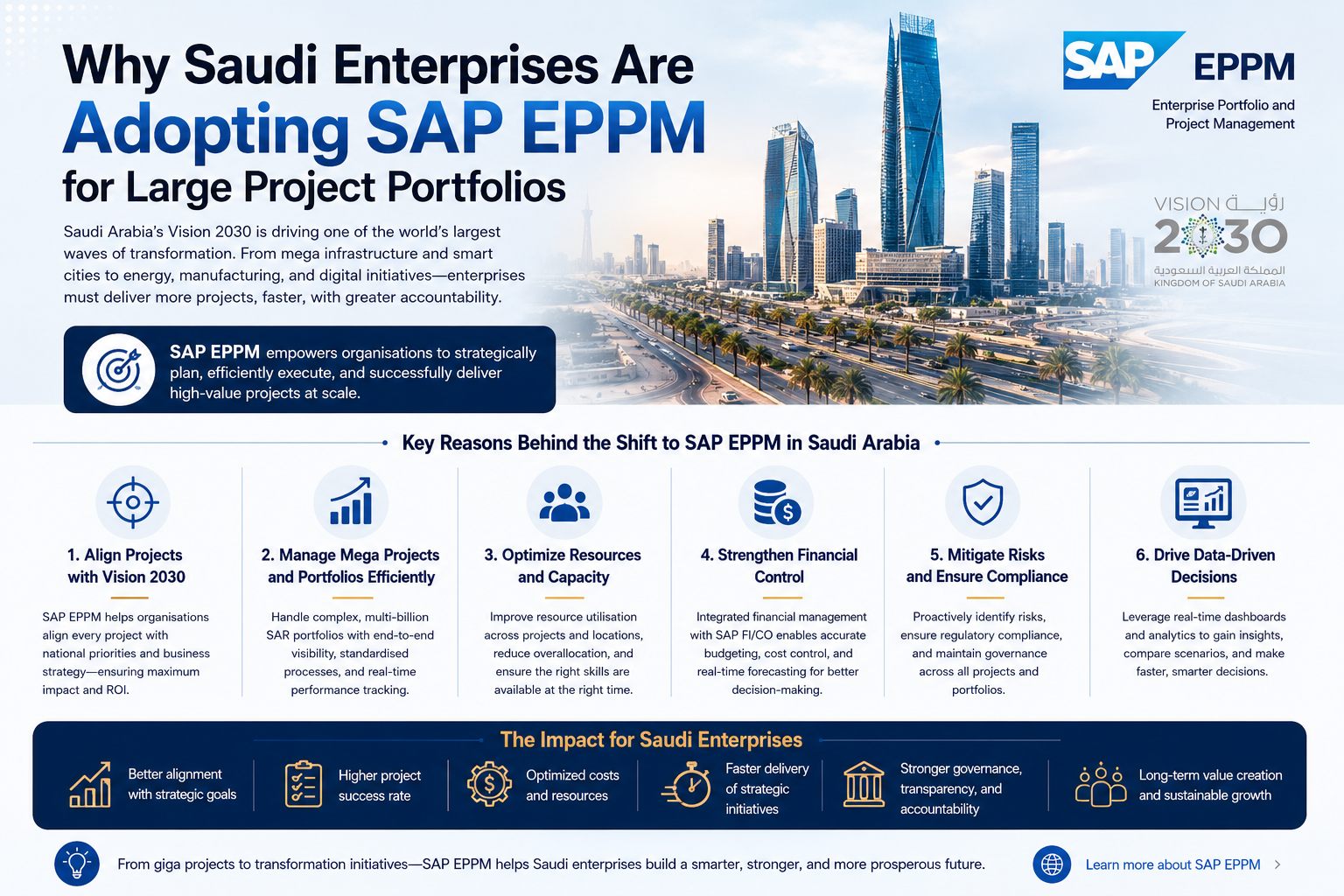
Saudi enterprises are adopting SAP EPPM because Vision 2030 has created an unprecedented volume of large, simultaneous capital projects that spreadsheets and siloed tools cannot govern. SAP EPPM, which combines SAP Project System (PS), SAP Portfolio and Project Management (PPM), and SAP Commercial Project Management (CPM) into one integrated platform, gives Saudi organisations in oil and gas, EPC contracting, infrastructure, and government sectors a single system to plan, prioritise, execute, and financially control entire project portfolios in real time.
Introduction: Saudi Arabia Has a Project Scale Problem
Saudi Arabia is building at a pace no other country in the world is currently matching. Vision 2030, the Kingdom’s national transformation plan, has placed over SAR 12 trillion in planned investments into motion across smart cities, energy infrastructure, tourism, and industrial zones. NEOM, Qiddiya, Red Sea Global, Diriyah Gate, Rua Al Madinah, and King Salman Park are not individual projects. They are interconnected, multi-decade, multi-billion-dollar programs running at the same time.
That creates a specific operational crisis for Saudi enterprises: how do you manage fifty or a hundred large capital projects simultaneously, maintain financial discipline across all of them, allocate limited resources without conflict, and deliver accurate progress reports to leadership and regulators?
The answer is enterprise-grade project portfolio management. And in the SAP-dominant enterprise landscape of the Kingdom, that answer is SAP EPPM.
What Is SAP EPPM? A Clear Definition
SAP EPPM (SAP Enterprise Portfolio and Project Management) is an integrated suite within SAP S/4HANA that enables organisations to manage all projects across the enterprise from a single platform, covering every stage from initial planning and resource allocation through to financial closure.
SAP EPPM is not one module. It brings together three distinct SAP solutions under a unified architecture:
SAP Project System (PS) is the execution engine. It manages work breakdown structures (WBS), network scheduling, Gantt charts, cost tracking, budget control, and integration with SAP Finance and Logistics. SAP PS serves the financial, accounting, and logistical needs of all CAPEX, OPEX, and revenue project scenarios.
SAP Portfolio and Project Management (PPM) is the strategic layer. It handles initiative classification, portfolio prioritisation, capacity planning, and strategic alignment. Ideas are evaluated, scored, and prioritised at the portfolio level before resources are committed.
SAP Commercial Project Management (CPM) is the commercial and financial intelligence layer. It has three core components: Project Workspace, Financial Planning, and Project Issue and Change Management. CPM connects project delivery to commercial outcomes, tracking what each initiative costs against the revenue or value it delivers.
Together, these three components form the complete picture that Saudi enterprises running large, complex portfolios need.
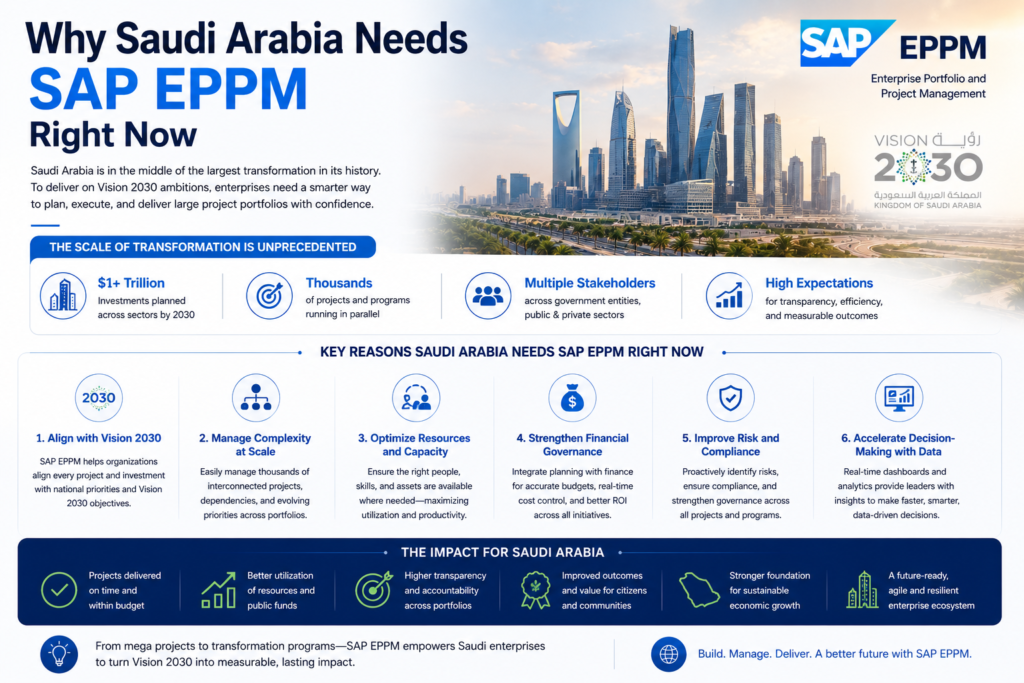
Why Saudi Arabia Needs SAP EPPM Right Now
Vision 2030 Has Created Unprecedented Project Complexity
Saudi Arabia’s Vision 2030 program aims to diversify the economy away from oil and invest in a knowledge-based society. The digital economy alone is targeted to contribute 15% of GDP, with the ICT market surpassing SAR 180 billion in 2024, making it the largest technology market in the Middle East.
The infrastructure sub-sectors supporting this are each growing at 5 to 6% annually. NEOM recently reported an $8 billion write-down, which directly illustrates the consequence of insufficient portfolio-level financial governance. When projects of this scale run without enterprise controls, the financial exposure is not measured in millions. It is measured in billions.
SAP Is Already the Enterprise Backbone in Saudi Arabia
SAP has made a $77.65 million investment in Saudi Arabia over four years to support Vision 2030, focusing on artificial intelligence, data management, and local talent development. The SAP Business Network, with global transactions surpassing $5 trillion, is being localised for the Saudi market in 2025. The enterprise technology infrastructure of most large Saudi organisations already runs on SAP. Adopting SAP EPPM is a natural extension of what is already in place, not a disruptive replacement.
Disconnected Systems Are Failing at Scale
Many organisations currently rely on data distributed across multiple spreadsheets, separate project scheduling tools, and isolated cost planning systems. That approach creates reporting gaps, resource conflicts, and financial blind spots. It works for managing three or four projects. It fails completely when managing portfolios of fifty or more simultaneous capital programs, which is exactly the situation Saudi enterprises now face.
Six Reasons Saudi Enterprises Are Choosing SAP EPPM
1. Single Source of Truth Across the Entire Portfolio
SAP EPPM gives leadership a unified, real-time view of every project in the portfolio, covering cost, schedule, resources, and commercial performance. Finance, project management, and executive reporting all draw from the same data. This eliminates the version conflicts and reporting inconsistencies that plague organisations using disconnected tools.
For Saudi state-owned enterprises and large conglomerates managing dozens of active projects across multiple business units, this single-source model is the most operationally significant benefit SAP EPPM delivers.
2. Integrated Financial and Resource Controls
SAP EPPM integrates directly with SAP FICO for real-time financial visibility, SAP HCM for resource and capacity management, and SAP MM and SD for procurement and logistics. Actual costs captured through WBS elements and network activities flow directly into portfolio-level reporting. Time booked by resources through SAP CATS in HCM is reflected automatically in project plans.
This tight integration means Saudi project owners do not need to manually reconcile data between systems. Financial exposure and resource utilisation are always current.
3. Strategic Portfolio Prioritisation When Capital Is Constrained
Not every project in a Saudi enterprise’s portfolio can run at full speed simultaneously. Capital is finite. Engineers are finite. Procurement capacity is finite. SAP PPM gives leadership a structured framework to score, rank, and prioritise initiatives based on strategic value, budget availability, and resource capacity before work begins.
This prevents the common failure mode of over-committing resources across too many projects, which is one of the primary drivers of cost overruns and schedule delays in large Saudi capital programs.
4. Deep Fit for EPC, Oil and Gas, and Infrastructure
Saudi Arabia’s project economy is dominated by Engineering, Procurement, and Construction. Leading Saudi EPC contractors are now securing project management consultancy contracts under the National EPC Champion Initiative, with a clear mandate for digital transformation and operational excellence.
SAP EPPM provides industry-specific configuration templates for EPC, oil and gas, infrastructure, manufacturing, and government programs. Implementations do not start from scratch. Saudi EPC and energy firms configure the system around project structures, contract types, and cost control workflows they already use.
SAP FICO integration provides real-time financial data. SAP HCM optimises resource planning and workforce assignment. SAP PS manages WBS structure and task linkage at the execution level. The full integration stack covers the specific operational complexity of Saudi capital projects.
5. Real-Time Visibility for Remote and Distributed Project Sites
Saudi giga-project sites are physically remote. Field teams working in Tabuk for NEOM, along the Red Sea coast, or in the Empty Quarter for oil and gas projects cannot wait for weekly consolidated reports to understand project status.
SAP EPPM delivered through SAP Fiori mobile applications gives field project managers, site supervisors, and commercial teams real-time access to project dashboards, cost reports, and issue logs from any device. Decisions that previously took days to reach the right people now happen in real time.
6. AI and Predictive Analytics Built Into the Platform
SAP S/4HANA 2025 enhancements for EPPM include expanded OData APIs for portfolio initiatives, planning integration with SAP Analytics Cloud, and support for SAP’s AI co-pilot Joule, which provides intelligent decision support across project execution. SAP Analytics Cloud delivers real-time KPI reporting, financial forecasting, and scenario planning directly connected to live project data.
For Saudi enterprises investing heavily in AI and digital infrastructure, an EPPM platform that evolves with those capabilities is a strategic asset with compounding value over time.
Which Saudi Sectors Are Adopting SAP EPPM
Oil and Gas: Saudi Aramco and the broader oil and gas supply chain manage multi-year capital projects with enormous financial complexity. SAP EPPM provides the governance layer to control costs, manage contractor relationships, and maintain portfolio-level financial discipline across all active programs.
EPC Contracting: Saudi EPC contractors managing simultaneous construction contracts across the Kingdom need portfolio-level resource allocation and financial controls that individual project tools cannot provide. SAP EPPM connects contract execution to commercial outcomes.
Government and Public Sector: Government entities and sovereign development funds running Vision 2030 programs require reporting frameworks that connect project delivery to national objectives, regulatory compliance, and public accountability.
Real Estate and Urban Development: Mega-project developers managing multiple urban programs across residential, commercial, and infrastructure segments need portfolio controls that span multiple contractors, geographies, and delivery timelines.
Manufacturing and Industrial: The non-oil sector now represents over 50% of Saudi GDP. The industrial base driving that shift depends on capital investment programs where cost control and schedule discipline directly determine profitability.
What SAP EPPM Implementation Looks Like in Saudi Arabia
A typical SAP EPPM implementation in a Saudi enterprise involves three phases.
The first phase configures the three core modules around the organisation’s specific project types, establishing WBS templates, cost element structures, portfolio scoring models, and financial planning frameworks suited to the industry.
The second phase connects SAP EPPM to the existing SAP S/4HANA or ERP environment, integrating live financial data from FICO, resource data from HCM, and procurement data from MM. This integration is what makes the platform genuinely useful rather than just another reporting layer on top of existing systems.
The third phase covers user adoption, SAP Fiori mobile configuration, SAP Analytics Cloud dashboard setup, and post-go-live support.
Organisations that have implemented SAP EPPM report 40 to 50% faster project portfolio decision-making and a 20 to 30% improvement in project profitability through tighter financial controls. Focused implementations covering a defined set of project types can go live in three to six months. Enterprise-wide programs spanning multiple business units typically run nine to eighteen months.
SAP EPPM and SAP S/4HANA: How They Work Together
SAP EPPM is native to SAP S/4HANA. SAP PS is a core S/4HANA module. SAP PPM and SAP CPM integrate directly within the S/4HANA architecture. This means that for Saudi enterprises already running S/4HANA for finance, procurement, and logistics, EPPM connects portfolio and project management to the data that already exists in the core system.
The practical benefit is significant. Actual project costs, procurement commitments, resource bookings, and revenue recognition all feed into portfolio-level reporting automatically, without manual data transfer or reconciliation between separate systems.
SAP also supports integration with third-party project scheduling tools such as Primavera and Microsoft Project through SAP Enterprise Project Connection (EPC), which allows Saudi organisations using Primavera for detailed scheduling to maintain that investment while gaining portfolio governance through SAP EPPM.
Related SaiSatwik Reading on SAP EPPM
For Saudi enterprises evaluating SAP EPPM, these companion posts cover the broader buyer picture:
- What is SAP EPPM and why top enterprises are switching to it — the definitional pillar; useful for stakeholders new to the module.
- SAP Investment Management vs SAP EPPM — the CFO decision when the capex programme mixes standing investments with project portfolios.
- Why enterprises are investing in SAP EPPM in 2026 — the Dubai / UAE regional companion to this Saudi piece.
Frequently Asked Questions About SAP EPPM in Saudi Arabia
What is SAP EPPM?
SAP EPPM stands for SAP Enterprise Portfolio and Project Management. It is an integrated suite within SAP S/4HANA that combines three modules: SAP Project System (PS) for project execution, SAP Portfolio and Project Management (PPM) for strategic prioritisation, and SAP Commercial Project Management (CPM) for financial and commercial oversight. Together they enable organisations to manage all projects across the enterprise from planning through to financial closure.
Why are Saudi enterprises adopting SAP EPPM specifically?
Saudi Vision 2030 has generated a volume and complexity of simultaneous capital projects that existing tools cannot govern. SAP EPPM gives Saudi organisations in oil and gas, EPC, infrastructure, and government sectors a single platform to plan, prioritise, execute, and financially control entire project portfolios in real time. SAP is already the dominant enterprise technology platform in the Kingdom, making EPPM a natural extension of existing systems.
What is the difference between SAP PS and SAP EPPM?
SAP PS (Project System) is one component within SAP EPPM. It handles detailed project execution including work breakdown structures, scheduling, cost tracking, and budget control at the individual project level. SAP EPPM as a complete solution adds SAP PPM for portfolio-level strategic prioritisation and SAP CPM for commercial financial management, giving organisations visibility and control at both the individual project and the full portfolio level simultaneously.
Which industries in Saudi Arabia use SAP EPPM?
SAP EPPM is used across oil and gas, EPC contracting, government infrastructure, real estate development, manufacturing, and utilities in Saudi Arabia. Any organisation managing multiple capital projects simultaneously with significant budget exposure benefits from the portfolio governance, resource control, and financial visibility SAP EPPM provides.
Does SAP EPPM integrate with SAP S/4HANA?
Yes. SAP PS is a native SAP S/4HANA module, and SAP PPM and CPM integrate directly within the S/4HANA architecture. Most enterprise SAP EPPM implementations in Saudi Arabia run within an S/4HANA environment, connecting project and portfolio data to finance, procurement, logistics, and human capital management in a single system.
How long does SAP EPPM implementation take in Saudi Arabia?
Focused implementations covering defined project types typically take three to six months. Enterprise-wide programs spanning multiple business units and integrating with complex existing SAP environments typically run nine to eighteen months. Implementation timelines depend on the number of project types being configured, the complexity of existing SAP landscapes, and the scope of user training and change management required.
Can SAP EPPM be deployed in the cloud in Saudi Arabia?
Yes. SAP EPPM is available both on-premise and via SAP S/4HANA Cloud Private Edition. Saudi organisations with specific data residency or regulatory requirements can work with certified SAP implementation partners to configure deployment models that meet local governance standards.
Does SAP EPPM work with Primavera or Microsoft Project?
Yes. SAP EPPM supports integration with third-party scheduling tools including Oracle Primavera and Microsoft Project through SAP Enterprise Project Connection (EPC). Saudi organisations using Primavera for detailed schedule management can maintain that capability while gaining portfolio-level governance and financial controls through SAP EPPM.
What are the reported benefits of SAP EPPM implementation?
Organisations that have implemented SAP EPPM report 40 to 50% faster portfolio-level decision-making and a 20 to 30% improvement in project profitability through better financial controls, real-time resource visibility, and structured portfolio prioritisation.
Conclusion
Saudi Arabia’s project economy is running at a scale and complexity that traditional project management tools were never designed to handle. Vision 2030 has placed hundreds of billions of dollars of capital investment into motion simultaneously, across sectors that are each growing rapidly and competing for the same engineers, contractors, and procurement capacity.
SAP EPPM gives Saudi enterprises the platform to govern that complexity. It connects strategic portfolio decisions to project execution to commercial financial outcomes within a single integrated system that sits inside the SAP S/4HANA environment that most large Saudi organisations already use.
For enterprises still managing project portfolios through spreadsheets and disconnected tools, the cost of that approach is now visible in project write-downs, schedule overruns, and resource conflicts that cannot be resolved without portfolio-level visibility.
For those ready to build the governance infrastructure their portfolios require, SAP EPPM is the logical and proven choice.
0 Comments